

Only your granted data
An app can read or write only the collections you granted it. An app built for your expenses can’t go rummaging through other collections.
A mini app only ever reaches the things you let it. Two pieces work together to make that true: the grants you give an app (the specific collections and workflows it may use) and the sandbox it runs in (which enforces that nothing outside those grants is reachable).
Every app is granted two lists, both by name, both chosen from things you already own:
You set these in the Properties pane of the editor. Each grant is a chip; you add one from a picker that lists your collections and your workflows by name. The app can only touch what’s on these two lists — nothing else in your account is visible to it.
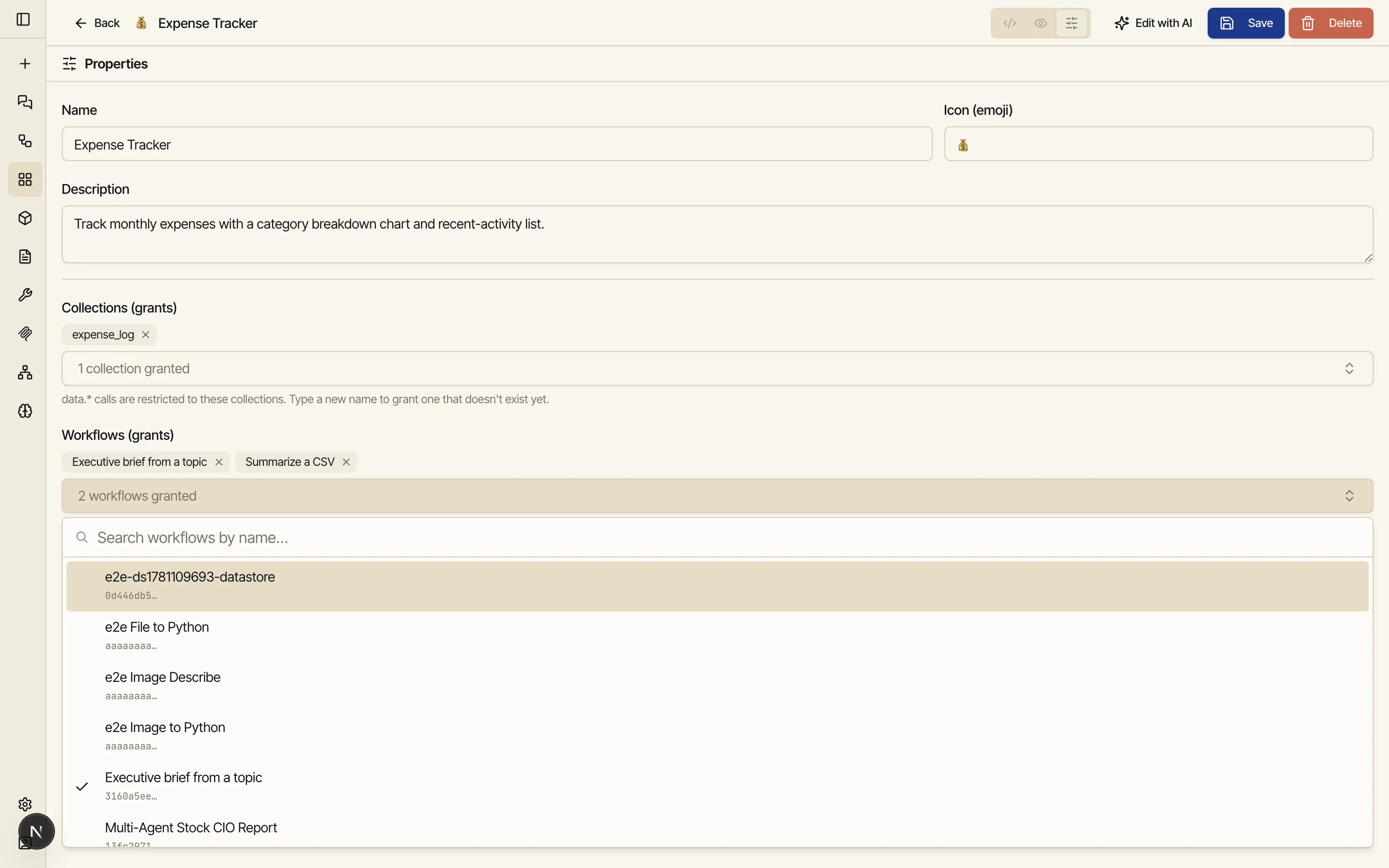
The collection picker lets you type a new name to grant a collection you haven’t created yet —
collections come into being on first write, so a not-yet-existing name is a valid grant. Give an app
a fresh collection name and it has a private place to store its data the moment it writes there. New
collection names follow the usual rule: lowercase, start with a letter, words joined by underscores
(for example meal_log).
The workflow picker only lists workflows you already have — a workflow has to exist before an app can run it. Pick the ones the app should be allowed to run; leave the rest out. If a granted workflow is later deleted, the editor keeps the grant visible so you can see and clear it rather than silently dropping it.
Grants decide what an app should reach. The sandbox is what makes sure it can’t reach anything else. Every app runs walled-in, and that’s a feature — it’s what makes it safe to run an app the assistant generated for you, or one someone publishes to the store that you fork.
Only your granted data
An app can read or write only the collections you granted it. An app built for your expenses can’t go rummaging through other collections.
Only your granted workflows
An app can run only the workflows on its list — and nothing else. It can’t trigger work you didn’t hand it.
No open internet
An app can’t call out to other websites or services. It only talks to the collections and workflows you gave it.
No access to your account
An app never sees your login or credentials — not your password, not your API keys, not your provider connections.
One capability deliberately reaches past the wall: an app can listen to your microphone — but only through Catalyst, which asks your permission, shows a Listening pill with a Stop button the whole time, and cuts capture off when you close the app. Everything else on your device — camera, location, clipboard, notifications — stays out of reach. See How mini apps run.
The short version: an app only sees the data you point it at. If an app needs to do something new, you give it a new workflow or a new collection — it can’t grant itself anything. That keeps a generated app, or one you fork from the store, from reaching anywhere it shouldn’t.
Because collections and workflows are shared assets — not owned by any one app — deleting an app removes only the app. The collections it read and the workflows it ran stay exactly where they were, and anything else that uses them keeps working.
Clearing your data in Your data empties the documents in your collections but leaves your apps in place, the same way it leaves your workflows.